|
|
Solid Earth Geophysics - Research
Although the Earth is approximately a solid sphere with
a radius of 6371 km, the interior structure is far from
being homogenous. Understanding this heterogeneity is
important to study interior material properties, mechanics
and dynamics. Our emphasis is on global seismology based
deep earth investigations and earthquake source properties.
We are currently interested in explaining deep earth
structures and dynamics of deep mantle, core-mantle
boundary and solid inner core.
Frequency dependent attenuation in the inner
coreBroadband velocity waveforms of PKIKP in the
distance range 150° to 180° are inverted for a
model of inner core attenuation due to forward scattering
by a three-dimensional heterogeneous fabric. A mean
velocity perturbation of 8.4%±1.8% and a scale
length of heterogeneity of 9.8±2.4 km are determined
from 262 available PKIKP ray paths. The velocity
perturbations are larger for polar than equatorial paths,
decrease with depth, and show anisotropy in both global and
regional data (Figure 1). For paths beneath North America,
the smallest scale lengths (1-5 km) tend to lie in either
the upper 200 km of the inner core or along paths close to
the rotational axis. The depth dependence of attenuation is
roughly similar to that obtained assuming a viscoelastic
origin, except a more abrupt transition is seen between
higher attenuation in the upper inner core and lower
attenuation in the lower inner core. This transition may be
sharp enough to produce either a first or second order
discontinuity with depth in the long-wavelength (composite)
elastic moduli. A fabric that satisfies the observed depth
dependence and anisotropy of attenuation requires
solidification of iron crystals having high (>10%)
intrinsic anisotropy, which are preferentially aligned in
time and depth. Since weak velocity dispersion, elastic
anisotropy, attenuation anisotropy, and their depth
dependence agree with that predicted by such a fabric, we
suggest that scattering attenuation is not a small fraction
but rather the predominant mechanism of attenuation in the
inner core in the 0.02 to 2 Hz frequency band.
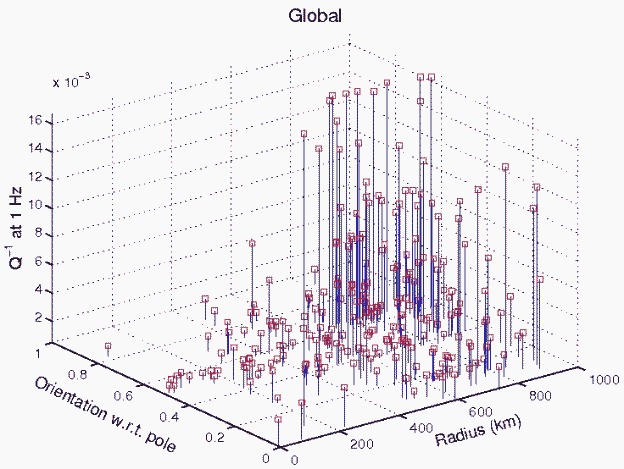
Figure 1
Regional variations of the upper most 100km of the
inner coreThe structure of the uppermost 100 km of the
inner core was examined from PKIKP and PKiKP waveforms in
the distance range of 118°–140°. We found
evidence of a low-velocity layer in the uppermost inner
core in the equatorial region predominantly located between
longitude 20°W to 140°E (Figure 2). In the
latitudinal direction the anomaly is detectable from
35°S beneath the Indian Ocean to 60°N underneath
Asia. The maximum thickness of the low-velocity layer
inferred from waveform modeling is 40 km with velocity jump
of about 3%. We speculate that this layer may represent
newly solidified core in the area where vigorous
compositional convection in the outer core coincides with
new crystal growth in the inner core.
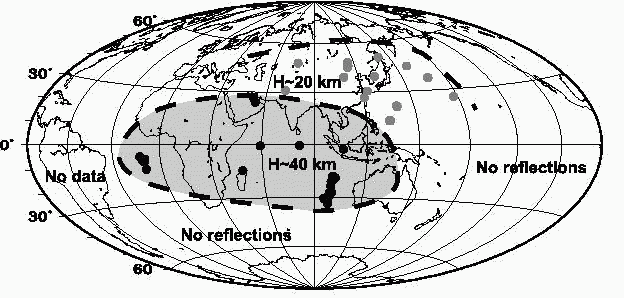
Figure 2
Waveform search for the inner most inner
coreWaveforms of the PKIKP seismic phase in the
distance range 150° to 180° are analyzed for
evidence of an inner-most inner core of the type proposed
by Ishii and Dziewonski having an abrupt change in elastic
anisotropy near radius 300 km (Figure 3a). Seismograms
synthesized in models having a discontinuity at 300 km
radius in the inner core exhibit focused diffractions
around the innermost sphere at antipodal range that are
inconsistent with observed PKIKP waveforms (Figure 3b).
Successful models have either a transition in elastic
properties spread over a depth interval greater than 100 km
or an innermost sphere that exceeds 450 km radius. Evidence
of a sharp discontinuity in the lower to mid-inner core is
sparse in existing global seismic data. Some examples,
however, can be found of PKIKP complexity near 161°,
consistent with a triplication created by a 475 km radius
discontinuity. An abrupt change in either viscoelastic or
scattering attenuation at this radius is also observed in
PKIKP waveforms, suggesting the existence of an innermost
sphere with low, regionally uniform, seismic attenuation.
In contrast to the relatively uniform inner-most inner
core, a 0 to 100 km thick region at the top of the inner
core exhibits strong lateral variations in attenuation and
velocity structure, suggesting lateral variations in the
processes of solidification, flow and re-crystallization at
the inner core/outer core boundary. Analogous to the
evidence for an abrupt fabric change in the upper-most
inner core, the seismic evidence for an innermost inner
core may represent another fabric change near 700 km depth
from the inner core/outer core boundary. This last and
deepest change may simply signify the end stage of
solidification, flow and re-crystallization, resulting in
the highest ordering and largest grain sizes of
intrinsically anisotropic crystals.
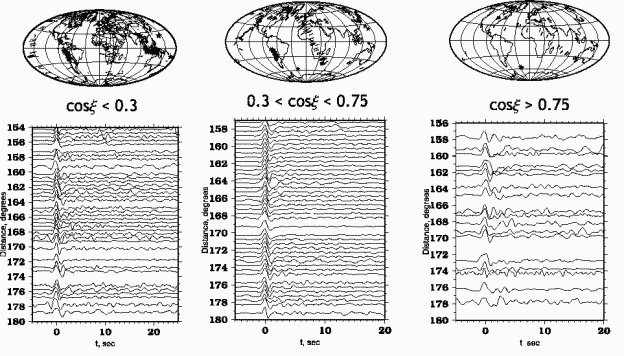
Figure 3a
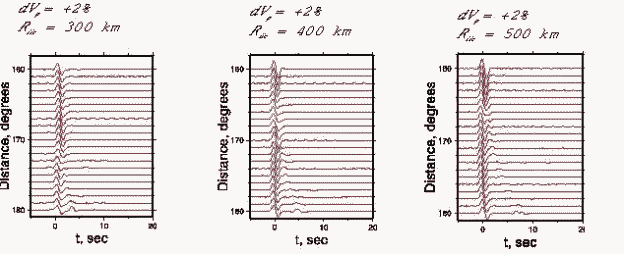
Figure 3b
|